


The highlights will give you the shadows.
The shadows will give you the method.
And the method will give the dream to your audiences.
– Tommy Wonder, The Books of Wonder
The first magic books I read were The Books of Wonder, and when I came across these words by Tommy Wonder, I was not only inspired, I realized that he had described the way I feel about my notebook.
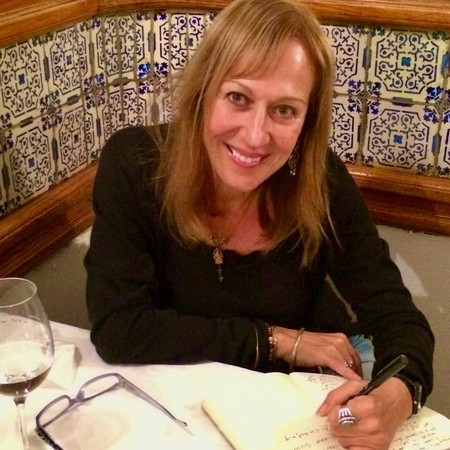
Let me start at the beginning. On my ninth birthday, my parents gave me a small blue diary with a lock on it. On the first page, I wrote: I want to be a writer. That never changed, though the diary/journal/notebook did. This little diary had a lock you could spring with a fingernail, but it was crucial because it said: No trespassers! This is Ruth’s world, and no one else is allowed in. I’ve kept countless notebooks since then, of all sizes so I can carry them when I travel. My new lock is that no one can read my handwriting but me, and sometimes I can’t decipher it either.
My wonder-full magical friends, you have been my muses for years. Maybe in return, I can encourage and inspire you by sharing how I keep a daily notebook.
The Shadows…
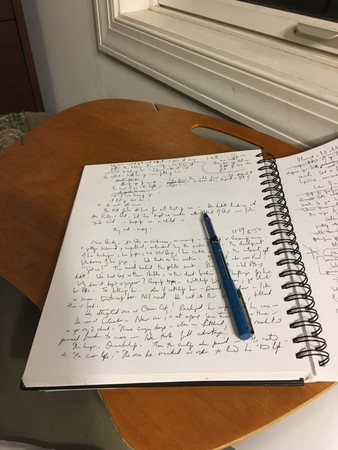
I write every morning, fresh from dreams, a cup of coffee in one hand, pen in the other. I write by hand in sketchbooks, no lines, no screens, nothing but my pen tracing shadows across the white pages. The act is intensely physical and sensual–the same quiet craft a magician practices alone with cards or coins long before the lights rise. I hug this private world between the covers of my notebook, and keep it intimate and mine for as long as I can, until the story, like a finished effect, threatens to burst free and live in front of others.
I’m not trying to make sense, not yet. I’m just trying to get fragments, words, images down in a safe place where the imagination roams free. As I write, I get into a groove, following a rhythm. Typing is something I do with my head. Handwriting is something I do with my hands. I believe that for magicians, much of your art lives in your hands. You know things through them that you cannot say out loud. You may have had a move solve itself while your hands worked, and your mind was elsewhere. You weren’t thinking about it, and then it was simply done, and you couldn’t have explained how.
Handwriting is closer to that than a screen will ever be. When I write longhand, I’m not describing a thought I already had. I am like a detective searching for clues. I don’t know the solution. I don’t even know exactly what the mystery is about, but I recognize a clue when I stumble over it. I pick it up and examine it in the light, and that leads me to the next clue. A detective groping in the dark, bumbling and blind, yet given moments of grace, a door blows open, light shines on a hidden path, and a whispered word lures me around the corner. I have no idea where it will lead, but I’m up for the adventure.
The Method…
Now I begin to glimpse patterns, shapes, and forms that connect like pieces in a puzzle that I play with until I see the best way to fit them together. There is a lot of deep play here. I can play because this is still secret. No-one knows about it but me. I can be fearless and try anything, and if it fails, I pick myself up and try again. My goal is to transform the shadows, clues, images, memories, and ideas into something tangible that I can envision in the real world–the same way a magician assembles a sequence of moves, until the effect itself begins to feel inevitable.
Sometimes I sketch it out and see if I can find the underlying shape that holds it together. I layer theme, plot, and dialogue. Here is where I ask questions about the scene, story, screenplay, essay, or whatever it is I’m creating. What is it really about? Not only the characters or setting, but what am I working towards? What is the heart of the piece? What reactions do I want the reader to have when they finish? How can I build it to get that reaction? Magicians ask the same questions of a routine: Where is the real moment of magic? What must be cut so the audience feels only that?
I shape like a sculptor, cutting away unnecessary words, trying to get at the heart of the piece.
As you know, this stage can take not only days and months but years of working on it until the epiphany moment when you finally see what it’s all about–why you’ve been haunted by it, and why you need to finish it.
I guard this secret for as long as I can. Sharing too early can destroy the magic. When it’s ready to burst from the pages, I type it up, imposing order, blocking letters on my wild scrawls, and putting up fences and doors. I discover things I hadn’t noticed before, make new connections, and shift the order of fragments. I turn it into something whole.
The Dream…
This is the movement from personal to public. Now is the time to test the dream in daylight, and share it with others. Rehearse in front of the mirror. I read it aloud to see if the rhythm has survived the editing. Does it translate into the real world? Does the script match the motions? Does your audience react the way you hoped they would?
Every piece I write, including this one, begins in my notebook. If I skip this step, I find that my writing lacks the raw, wild energy that creation needs. It’s like planting a tree on the surface of the ground and ignoring the roots below. I suggest you keep a notebook–not merely to preserve tricks or plot ideas, but to record what astonishes you: an image, a question, a fragment of dialogue, an emotion, a gesture, or a moment that seems to point beyond itself. The notebook is where you catch the moment before it turns ordinary again. It holds the magic moments and keeps the mystery alive.
Wishing you all a lovely season of Samhain and witchery!