

Some places exist not just as buildings, but as living vessels of knowledge, inspiration, and shared discovery. In this Museletter, Mystery School instructor Judge Gary Brown invites us into one such place, exploring the idea of the athenaeum and how the Mystery School Library continues a timeless tradition of artists and thinkers gathering to study, refine, and evolve their craft.

In ancient Greece, an athenaeum was a space dedicated to Athena, goddess of wisdom, where scholars and artists gathered to present, debate, and refine their work. Under Emperor Hadrian, the Romans adopted and expanded the idea, applying the term to institutions that resembled early universities. Faculty offered lectures and readings, sometimes before the emperor himself. In later centuries, the athenaeum evolved again, becoming the home of learned societies – buildings that combined libraries, collections, and spaces for assembly, performance, and inquiry.
Today, magicians can access an athenaeum hidden behind a secret door at the McBride Mystery School–the Library of Secrets. It fulfills the traditional functions of its predecessors and adds one more. Like the legendary “back rooms” of dealers such as Martinka and Flosso, it is a place where secrets may be shared freely among initiates. It is a crucible for inspiration, invention, and study, where magicians hone their craft, test their ideas, and enter a lineage of shared knowledge.
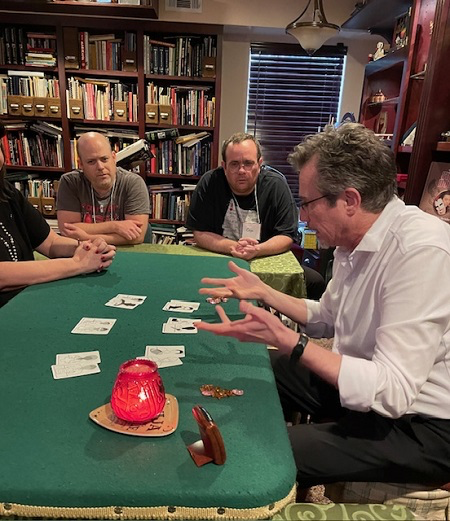
Those fortunate enough to have attended a Mystery School event are already familiar with the Library as a performance and lecture space. It is the heart of the school, where skilled magi teach and perform in a sumptuous parlor of mystery. In one class, I watched – awestruck – as Dean Larry Hass taught his version of a routine that I developed, an experience that will be hard to equal.
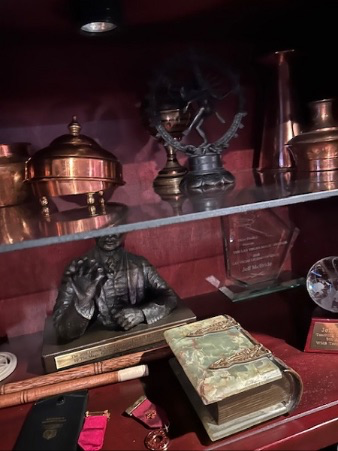
The surroundings are unforgettable. While learning from magic’s great teachers, participants are enveloped in a truly mystical environment. The shelves are lined with magical objects – exquisite, antique, and rare apparatus – visions of copper, chrome, and turned wood that can overwhelm first-time visitors. These artifacts are more than décor. Those who linger and study them closely might discover an 18th Century children’s magic set (complete with a bonus genius), a set of gimmicked matryoshka dolls, or a steampunk card duck. Examining these objects may yield a forgotten method or curious manifestation – one capable of igniting an entirely new routine. Recently, I acquired a Berg No Feke Card Frame from Viking Magic – a piece I snapped up because I had marveled at two similar card frames in the environs of the Library. The opportunity to examine this remarkable device in the Library revealed its potential for my repertoire.
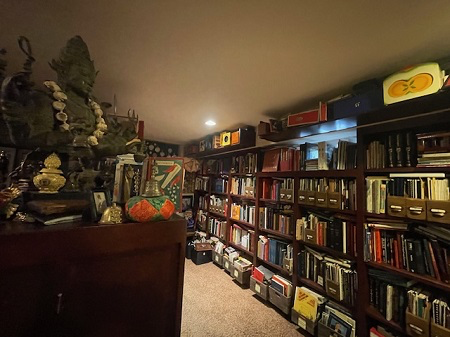
Of course, the space is principally a magic library, one that grandly lives up to its name. Thousands of books and periodicals line the main passageway, including aged volumes nestled among coveted contemporary items, like Derren Brown’s Notes from a Fellow Traveller and Steve Cohen’s Max Malini. While many of the items could justify preservation in acid-free boxes and mylar bags, not here. This is, as Jeff often explains, a working library where magicians come to solve problems and find inspiration. One could, for example, peruse a vintage copy of C. Lange Neil’s The Modern Conjurer, featuring photos of Golden Age magicians like T. Nelson Downs and John Nevil Maskelyne performing classic effects. A teacher might lead a student to a copy of The Magic of Johnny Thompson, which offers a detailed explanation of a baffling effect presented by a Las Vegas headliner the previous evening.
Make no mistake–this is a place where discoveries are made and secrets unearthed. A few years ago at a Mystery School event, I watched my friend and colleague Daniel Quintana (known professionally as Byron Grey) have a “Eureka!” moment in the Library. “I’d long been a fan of the beautiful ‘Astarte’ illusion, which John Gaughan presented at one of the History Conferences in Los Angeles,” Dan recalls. “Astarte is a beautiful piece which predated David Copperfield’s flying by 50-60 years or so.” Dan had been searching for some insight as to its workings. Then, he located the Library’s copy of the Burling Hull Book of Stage Illusions, a volume with a colorful publishing history that gained a kind of underground following. “Yes!” he exclaimed, as he turned a page. “It didn’t say it was the Astarte illusion,” Dan explains, “but it provided enough detail that I could ‘see’ it!”
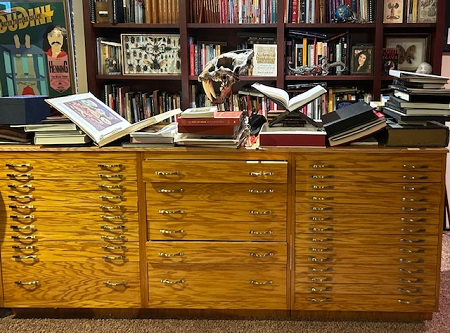
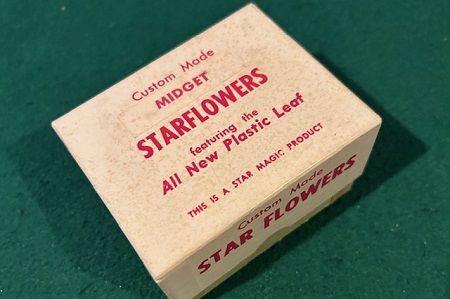
There is a secret to the Library that should not be missed. At its center rests a massive printer’s block filing cabinet that is, paradoxically, imposing yet easily overlooked. That piece houses the Ray Goulet Gimmick Collection, donated to the Mystery School after Ray’s passing. The drawers are packed with magical devices, gaffs and pocket tricks. Pull a handle and you might discover dozens of thumb tips, magic wands, production items or Japanese coin slides. Take time to compare a half dozen incarnations of the Vanishing Quarter, the Silk Wonder Box or the Zig Zag Playing Card. Considering different approaches to magical problems can offer insights into the creative process. Or you might discover, as I did, a box of “Custom Made Midget Starflowers featuring the All New Plastic Leaf” without figuring out exactly what they do…which is on my to-do list for my next visit!
During your next Mystery School course, you may notice an entry that says “Library Time” on the schedule. This is not a euphemism for an opportunity to grab a snack. Choose wisely – perhaps even plan ahead – and use that time to the fullest. You may be rewarded with a bit of wisdom.

Judge Gary Brown is the author of Wandcraft and The Inventive Magician’s Handbook. He is also a Visiting Teacher and a former Ray Goulet Scholar at the Magic & Mystery School. In this Museletter, Gary shares his thoughts about the athenaeum.